





 Medically reviewed by:
If you’re a registered nurse (RN) looking for more autonomy working with patients in an operating room, intensive care unit, or surgical facility, then becoming a Certified Registered Nurse Anesthetist (CRNA) might be the perfect job for you.
CRNAs are highly respected for their work and, according to U.S. News & World Report, Nurses Anesthetists rank #10 in Best Health Care Job in 2023. They are also the highest-paid nurses of 2023 (the average CRNA salary is $203,090!) Read on to find out how to become a CRNA, what they do, and more.

Part One What is a Nurse Anesthetist (CRNA)?
Nurse Anesthetists (CRNAs) are advanced practice registered nurses (APRNs) who administer anesthesia and other medications.
They monitor patients receiving and recovering from anesthesia. CRNAs have acquired a minimum of a doctorate degree focusing on anesthesia, completed extensive clinical training, and passed a certification exam approved by the National Boards of Certification and Recertification of Nurse Anesthetists (NBCRNA).
CRNAs care for patients from all walks of life. Some patients are scheduled for surgery, while others come in for emergency surgeries related to trauma or other potentially life-threatening events.
CRNA Salary
$203,090 per year
Degree Requirements
DNP or DNAP Degree
How Long to Become
7-10 years
Related: CRNA vs Anesthesiologist: What’s the Difference?
Part Two How to Become a Nurse Anesthetist
It takes about 7-10 years to become a nurse anesthetist. In order to become a CRNA, you'll need to meet CRNA school requirements, complete an accredited program, and earn your certification. You can complete these requirements using the following steps:
- Shadow a CRNA
- Earn your Bachelor of Science in Nursing – 4 years
- Gain ICU experience – 1-3 years
- GRE & Certifications
- Recommendations and Essay
- Interview Prep
- Complete Your CRNA program - 2-3 years
- Take and pass the National Certification Examination for Nurse Anesthetists - Eligible Upon Graduation
Let’s take a closer look at what each step entails, including tips from Dr. Charnelle Lewis, DNP, CRNA. You can see her full explanation of how to become a nurse anesthetist in the video below.
1. Shadow
According to Dr. Charnelle Lewis, "Becoming a CRNA is not for everyone." She recommends shadowing as your first step to make sure it’s something you enjoy.
2. Earn your Bachelor of Science in Nursing
You will need your bachelor’s of nursing or related bachelor’s degree as well as an RN license in order to be eligible for a CRNA program.
Most CRNA programs have a minimum GPA requirement of 3.0, and acceptance is becoming increasingly competitive.
3. Gain ICU Experience
Nurse anesthesia programs prefer candidates who have worked in the intensive critical care unit (ICU) with adult patients. You should have a minimum of 1 year of experience working in an ICU unit, but Dr. Lewis says, "the average incoming class has approximately 2.5 years of ICU experience."
Examples of ICUs you can work in are: CVICU/CTICU, MICU, SICU, BTICU, Neuro ICU, PICU.
Dr. Lewis adds that "some schools accept ER, CCU, and NICU, but it is best to check with the school to be sure."
4. GRE and Certifications
According to Dr. Lewis, there are some schools that don't require the GRE, but you'll need a high GPA in order to be a competitive applicant for those schools.
The CCRN or critical care certification is generally not listed as a requirement but is preferred and will help give you an edge over other applicants.
5. Recommendations and Essay
Dr. Lewis says that your recommendations are a crucial step in the application process. She recommends making sure you are "networking, making connections, and staying involved in your unit because you will need people to speak about your abilities and skills."
She also suggests keeping track of your accomplishments and shadow experiences. "Your personal essay is key to showing the admissions committee who you are and why you are right for the program!"
6. Prepare for Your Interview
While you're waiting to find out if you've been accepted, Dr. Lewis recommends using this time to prepare for your interview, "Grab a copy of Duke's Anesthesia Secrets and review your CCRN materials for the clinical portion."
7. Complete Your CRNA Program
Earning your degree will take between two and three years and will provide both high-level classroom work and clinical practice. Most CRNA schools are fully in-person, but a few universities offer hybrid online CRNA programs for increased flexibility. Students in these programs enjoy some online coursework alongside their in-person requirements.
>> Related: CRNA Schools by State
8. Pass the National Certification Examination for Nurse Anesthetists
All nurse anesthetists must pass the CRNA exam prior to beginning to practice. The National Board of Certification and Recertification for Nursing Anesthetists (NBCRNA) outlines eligibility, registration processes, exam details, and renewal procedures in its Examination Candidate Handbook.
Once you pass the exam and have become a CRNA, you must maintain certification, which involves recertifying every four years and taking a new test every eight years.
Recertification requires the completion of 100 units of continuing education in a variety of areas, including pathophysiology and anesthesia technologies.
>> Related: CRNA vs Anesthesiologist: What’s the Difference?
Part Three What Do CRNAs Do?
In many states, CRNAs work with complete autonomy. In other team models, they work with anesthesiologists, surgeons, dentists, and other physicians in serving patients who are to receive anesthesia. But what does a nurse anesthetist do on a day-to-day basis?
In this specialty nursing career, you'll usually work in hospital operating rooms (ORs), emergency rooms (ERs), intensive care units (ICUs), cardiac care units (CCUs), or outpatient surgical clinics.
CRNAs work with surgical teams, and most surgical procedures occur from early morning (6 am) to late afternoons/evenings (6-7 pm), Monday through Friday. However, emergency surgery and unplanned cases can occur at any moment, so it is not unusual to see CRNAs working evenings, nights, weekends, and holidays.
CRNAs have specific duties, which include but are not limited to:
- Assessing patient response to anesthesia
- Identifying possible risks to the anesthetized patient, including allergies and overdose
- Administering precise dosages
- Educating patients before and after receiving anesthesia
Part Four Nurse Anesthetist Salary
Nurse anesthetist's salaries are some of the highest in the field. Depending on the work setting and state where they are employed, the U.S. Bureau of Labor Statistics (BLS) reports that the median average nurse anesthetist salary is $203,090 as of their most recent survey in 2022.
Highest Paying States for CRNAs
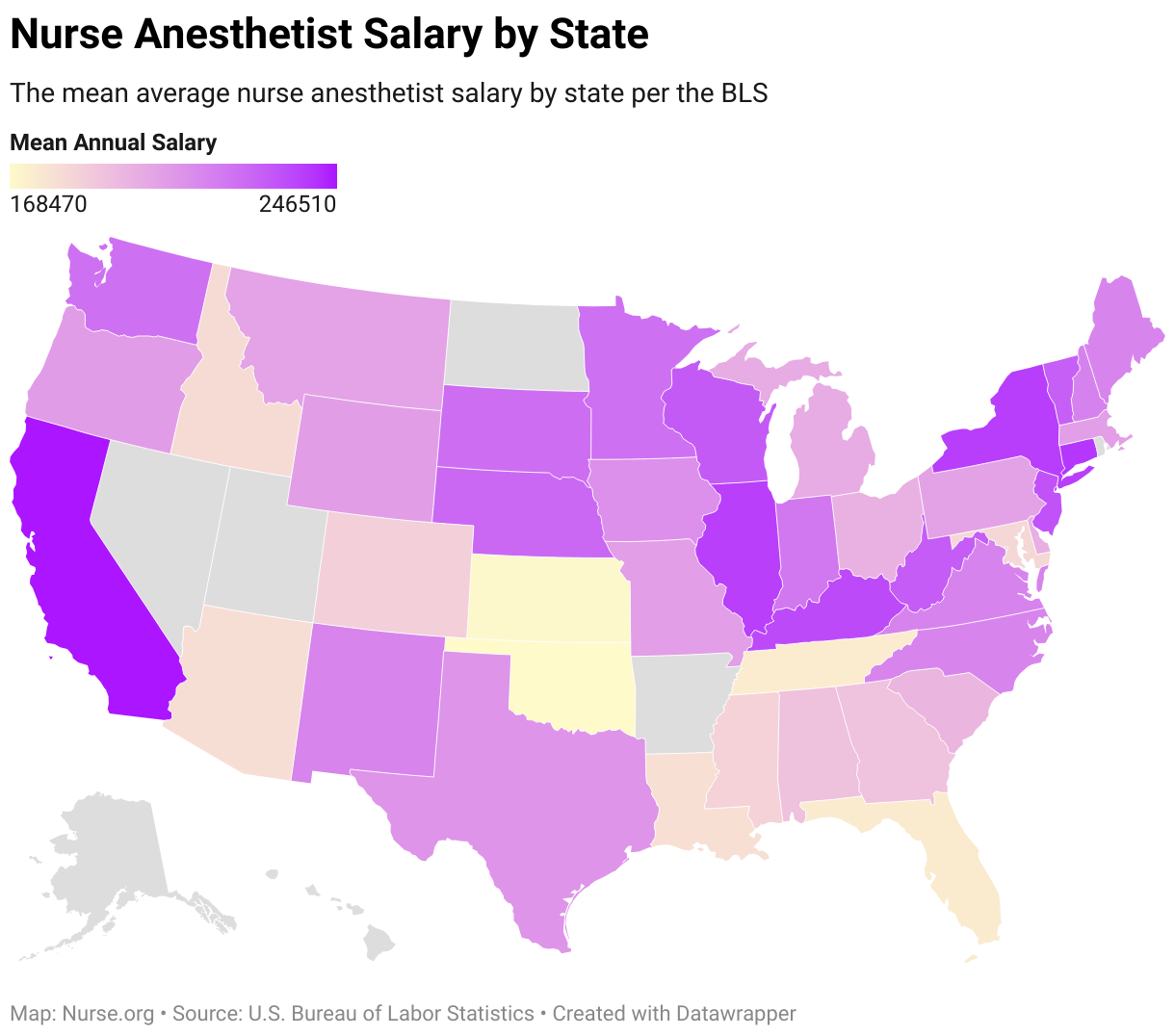
The top 4 states with the highest mean annual average salaries for nurse anesthetists are:
| California | $246,510 |
| Connecticut | $240,580 |
| New York | $238,710 |
| Illinois | $238,440 |
Source: BLS
Nurse Anesthetist Salaries by State
Here's a map of all the United States and the average CRNA salary for each per the BLS.
CRNA Salary by State
| State | Annual Mean Salary |
| Alabama | 191,200.00 |
| Arizona | 179,730.00 |
| Arkansas | - |
| California | 246,510.00 |
| Colorado | 185,860.00 |
| Connecticut | 240,580.00 |
| Delaware | 198,070.00 |
| Florida | 174,390.00 |
| Georgia | 190,800.00 |
| Idaho | 181,110.00 |
| Illinois | 238,440.00 |
| Indiana | 220,020.00 |
| Iowa | 211,010.00 |
| Kansas | 169,410.00 |
| Kentucky | 235,260.00 |
| Louisiana | 179,140.00 |
| Maine( | 214,930.00 |
| Maryland | 182,710.00 |
| Massachusetts | 204,690.00 |
| Michigan | 199,690.00 |
| Minnesota | 222,540.00 |
| Mississippi | 184,390.00 |
| Missouri | 205,190.00 |
| Montana | 203,430.00 |
| Nebraska | 225,590.00 |
| New Hampshire | 215,970.00 |
| New Jersey | 232,630.00 |
| New Mexico | 215,240.00 |
| New York | 238,710.00 |
| North Carolina | 214,740.00 |
| North Dakota | - |
| Ohio | 197,630.00 |
| Oklahoma | 168,470.00 |
| Oregon | 205,920.00 |
| Pennsylvania | 203,620.00 |
| Puerto Rico | 63,570.00 |
| South Carolina | 195,840.00 |
| South Dakota | 223,200.00 |
| Tennessee | 174,170.00 |
| Texas | 208,940.00 |
| Vermont | 228,710.00 |
| Virginia | 215,530.00 |
| Washington | 222,610.00 |
| West Virginia | 229,430.00 |
| Wisconsin | 230,270.00 |
| Wyoming | 205,270.00 |
Source BLS, Date extracted: September 22, 2023
Part Five Where Do CRNAs Work?
CRNAs typically work in healthcare settings that have operating rooms, emergency rooms, and intensive care units.
CRNA Work Environments
- Medical and surgical hospitals
- Critical access hospitals
- Mobile surgery centers
- Outpatient care centers
- Nursing research facilities
- Offices of plastic surgeons, dentists, ophthalmologists, pain management specialists, and other medical professionals
- U.S. military medical facilities
While most CRNAs choose to practice at the bedside, there are also numerous administrative jobs available for Nurse Anesthetists. Individuals can work in a managerial role that includes personnel and resource management, financial management, quality assurance, risk management, department meetings, continuing education, and staff development.
Furthermore, CRNAs may hold positions within state and federal government agencies, including the state boards of nursing, U.S. Food and Drug Administration, and for professional testing organizations such as the American Society for Testing and Materials.
Part Six Which Schools Have the Best CRNA Programs?
There are numerous CRNA programs in the US; our panel of nurses ranked them based on reputation, certification pass rate, cost, accreditation, and acceptance rates and determined these are some of the best options out there. See the full list of the best nurse anesthetist programs!
Top 10 Nurse Anesthetist Programs
1. Duke University
Total Program Cost: $69,736 (based on per-credit tuition rate)
Online: No
Program Length: 36 months

2. Mayo Clinic College of Health and Sciences
Total Program Cost: $62,610
Online: No
Program Length: 42 months
3. Villanova University
Total Program Cost: $94,000
Online: No
Program Length: 36 months
4. Virginia Commonwealth University
Total In-State Program Cost: $52,272
Total Out-of-State Program Cost: $94,446
Online: Hybrid
Program Length: 36 months
5. Rush University
Total Program Cost: $103,774 (based on per-credit tuition rate)
Online: Hybrid
Program Length: 36 months
6. Georgetown University
Total Program Cost: $146,512
Online: No
Program Length: 36 months
7. Baylor University
Total Program Cost: $98,686
Online: Hybrid
Program Length: 36 months
8. University of Cincinnati
Total In-State Program Cost: $46,242
Total Out-of-State Program Cost: $81,468
Online: Hybrid
Program Length: 36 months
9. Northeastern University
Total Program Cost: $124,000
Online: No
Program Length: 36 months
10. University of Pittsburgh
Total In-State Program Cost: $82,770
Total Out-of-State Program Cost: $98,844
Online: No
Program Length: 36 months
Pitt's DNP in nurse anesthesia program has been considered among the best for decades. The three-year program places RNs in clinicals around the area (including University of Pittsburgh Medical Center hospitals, considered some of the top hospitals in the nation. Students begin the program with coursework, then gradually begin clinical practice. Once accepted, students are paired with faculty advisors to figure out how to quickly finish coursework so students can progress to clinical practices without worrying about courses.
Part Seven Nurse Anesthetists Top Tips on Becoming CRNAs
We asked leaders in the nurse anesthesia field for their best advice for nurses who want to become nurse anesthetists.
Joseph A. Rodriguez, MSN, CRNA, President of Arizona Association of Nurse Anesthetists

Second, get used to constant advocacy. CRNAs only exist because we’ve battled, for over 100 years, just for the right to do our job and take care of our patients.
Third, you must properly – and frequently - articulate your practice to others who likely know nothing about your practice. Few people (even surgeons, physicians, and nurses) understand the knowledge, background, and capabilities of CRNAs, and fewer will know that you have a deep understanding of perioperative anesthetic management.
Last, surgery and anesthesia are all about teamwork, not egos - the only measurement that ever matters - is the safety of our patients.
Kris Rohde CRNA, MSN, BSN, President-Elect of the Nebraska Association of Nurse Anesthetists

I also think that a nurse working in critical care will develop skills that are crucial to our profession. Understanding laboratory results, ventilator settings, & EKG interpretation are just the tip of the iceberg for us. A successful CRNA understands all of those things, plus the pathophysiology behind it. Working in an ICU or other critical care areas will also help an RN develop critical thinking skills that are absolutely essential to a CRNA. This is something that is learned over time, not just in a year. I truly believe that applying for school when one is ready, not just after the minimum requirement, is important.
Shawn Seifert, MS, CRNA, President-Elect of the Maryland Association of Nurse Anesthetists

That is, seek opportunities outside of the purely clinical and be involved politically, socially, or even artistically.
These experiences will allow you to evolve into the advanced role of nursing leadership that Nurse Anesthesia demands as well as makes your application for school more impactful and likely to lead to an interview.
Marcia Kluck, MNA, APRN, CRNA, President-Elect of the Minnesota Association of Nurse Anesthetists

Cheryl L. Nimmo, DNP, MSHSA, CRNA, President of the American Association of Nurse Anesthetists

After becoming an RN, you will need to obtain at least one year of experience working in an intensive care setting. My recommendation: Work for 2-3 years at a minimum before applying for nurse anesthesia school. Absorb advice and information like a sponge and become the best intensive care nurse you can be.
Find a CRNA and ask if you can shadow him/her in the OR for a day. This will give you a total picture of what the career entails. Also, get your CCRN certification. Obtaining the certification shows that you are able to learn and retain new concepts and shows that you have the motivation to learn while working.
Also, if you had a science course and your grades were not outstanding, take another science course before applying to show you are capable of the science courses in anesthesia school. This will position you well for the next stage of your career…as a CRNA! Good luck in your future career.
Gus Powell, CRNA, President-Elect of the Idaho Association of Nurse Anesthetists

In addition, it is very important to gain as much clinical exposure as possible while working as an RN and applying to anesthesia programs. I also feel it is helpful to find a CRNA mentor and shadow that person for enough time to really establish if this profession is for you. Becoming a CRNA is very rewarding and challenging. I have never regretted my decision to become a CRNA. Good luck to you!
Maricel Isidro-Reighard, CRNA, MSNA, DNAP, President of the California Association of Nurse Anesthetists

Our peers will have high expectations of us, and we have to know how to deliver. Don’t think that just because you have “CRNA” behind your name, that immediate ‘carte blanche’ is granted to you. It is, in fact just the opposite! We have to prove ourselves every single day! There is no doubt that in your CRNA career, you will need their helping hands and their moral support, and they will give it you almost 100% if they see that you did not shoot way too far into the stratosphere when you became a CRNA.
Christopher Bartels, CRNA, President of the Connecticut Association of Nurse Anesthetists

Part Eight What is the Career Outlook for CRNAs?
The job prospects for CRNAs are excellent. Healthcare legislation, increased emphasis on preventative care, an increasing number of insured patients, and an aging patient population have led to more patients seeking medical care.
The BLS estimates that the projected job growth for CRNAs between 2022 and 2032 will be 38%, much faster than the expected job growth for RNs. As noted above, many rural areas are already using high numbers of CRNAs when they are available, and this is expected to increase significantly. Many organizations are utilizing them in place of anesthesiologists due to availability and costs.
Part Nine Where Can I Find More Information On CRNA Careers?
The American Association of Nurse Anesthetists (AANA) is an excellent resource for those interested in more information about this career path. AANA offers information about continuing education, advocacy, and upcoming annual meetings.
Additionally, Nurse.org is an invaluable resource for everything you need to know about a career as a CRNA and about CRNA programs. You’ll find the answers to all of your questions in these articles:
Becoming a Nurse Anesthetist is a lot of work, but with that title comes a rewarding and lucrative career. If your goal is to take your RN career to the next level, look into becoming a CRNA.

*Indicates an affiliate link. At no additional cost to you, Nurse.org will earn a commission if you click through and use this service.
$100,000+ CRNA Doctorate Bedside